
Data Engineering
Data Warehousing Setup: A Step-by-Step Guide for Growing Companies
Parix Digital Team · 28 June 2026 · 8 min read
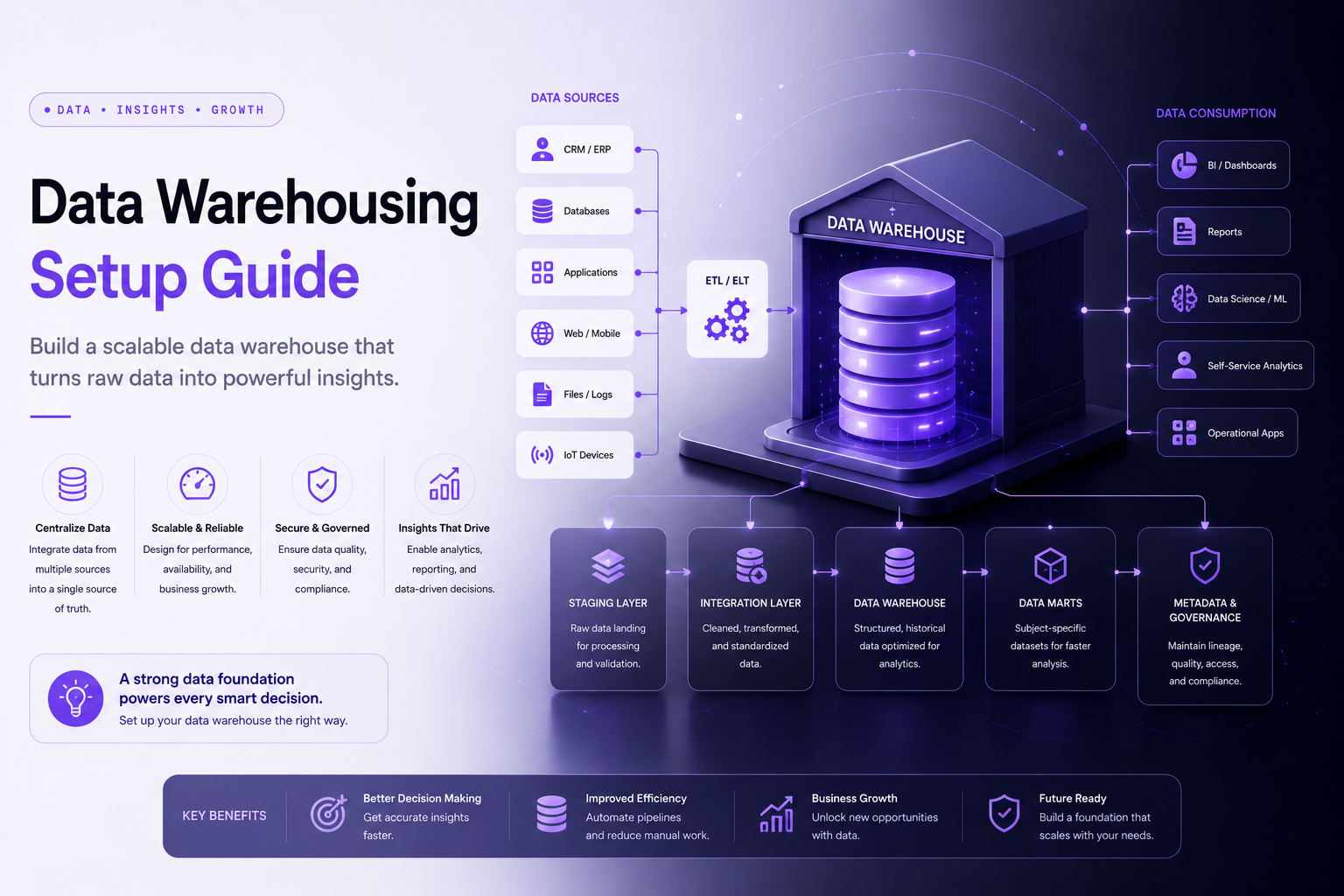
Key Takeaways
- A data warehousing setup consolidates every business tool into one governed source of truth for reporting, BI, and AI.
- The core steps: audit sources, choose a platform (Snowflake, BigQuery, Redshift), build ELT pipelines, model with dbt, and add governance.
- Skipping data modeling and governance is the most common reason warehouse projects fail to earn trust.
Discuss this page with AI
Open your AI assistant with this page loaded to summarise it, ask questions, and go deeper.
What a data warehouse actually is
A data warehouse is a central database designed for analysis: it stores clean, historical data from every tool you use, so any question can be answered from one trusted place instead of five conflicting exports.
It differs from your operational databases, which are built for running the business, not analysing it. Separating the two is what keeps dashboards fast and production systems safe.
Step 1-2: Audit your sources and choose a platform
Start with an inventory: CRM, accounting, ad platforms, ERP, spreadsheets, and SaaS APIs. Then choose the platform. Snowflake suits multi-cloud flexibility and strong governance; BigQuery suits Google-stack teams and spiky workloads; Redshift suits AWS-heavy stacks. All three offer US and UK/EU regions for data residency.
Step 3-4: Pipelines and data modeling
ELT pipelines (Fivetran, Airbyte, or custom) load raw data on a schedule with alerting and retry logic. Then modeling turns raw tables into clean, documented, reusable models, typically star schemas built with dbt, so "revenue" means the same thing in every report.
Step 5-6: Governance and the BI layer
Governance is what makes the warehouse trustworthy: automated data tests, role-based access, column-level lineage, and PII masking aligned with UK GDPR and US privacy laws such as the CCPA. Finally, a semantic layer feeds Power BI, Looker, or Metabase so teams self-serve from curated datasets.
Common setup mistakes to avoid
The failure patterns repeat across companies of every size:
- Loading everything with no modeling layer (a data swamp, not a warehouse)
- No data-quality tests, so the first wrong number kills trust
- Dashboards querying production databases directly
- Ignoring cost controls until the first surprise bill
- No owner for the pipeline when it breaks on a Monday
Work With Parix Digital
Parix Digital delivers complete data warehousing setups: platform, pipelines, dbt models, governance, and BI, for companies in the USA, UK, and India. Reach us at [email protected].
Parix Digital Team
The Parix Digital team builds custom AI tools, ERP-MRP systems, scalable eCommerce, and data-driven marketing for businesses ready to scale.
FAQ
Frequently Asked Questions
How long does a data warehousing setup take?
A focused setup (core sources, models, and dashboards) typically lands in 4-8 weeks, then grows source by source.
Snowflake, BigQuery, or Redshift: which is best?
It depends on your stack, scale, and budget. We are platform-agnostic and recommend based on your needs; all three offer US and UK/EU data residency.
Do we need a warehouse before doing AI?
Effectively yes. Clean, governed, historical data is the foundation every serious AI and forecasting project stands on.
Have a project in mind?
Tell us about your goals and current setup. We'll get back to you within 24 hours with a tailored plan.
UK · India · USA | Enterprise Grade Delivery | 24hr Response Time